Friday, March 23, 2012

[BOW 2-8] The Biogeochemical Cycles.

When are these elements "bio?"
When living organisms are involved in the process, that step is biological. For example, a tree releasing oxygen is considered biological.
When are they "geo"?
When it takes place underground in the dirt, it's geological.
When are they chemicals in air and water?
When the chemicals are released into the air or water by the exhalation of marine animals and land animals, or smoke and fog.
Why is it important that these are cycles?
Cycles ensure that the process will continue to happen. The cycle spreads through the lands, air, and organisms, so it's evenly spread.


References:
http://en.wikipedia.org/wiki/Biogeochemical_cycle

Thursday, March 15, 2012

[BOW 2-7] Food Web.

Producers: leafs, grapes
Primary Consumers: grasshopper, rabbit, squirrel
Secondary Consumers: fox, owl, snake, frog
Tertiary Consumers: mouse
Scavengers/De-composers: none.

References:
http://en.wikipedia.org/wiki/Consumer_%28food_chain%29

Thursday, March 8, 2012

[BOW 2-6] Geographic Distribution.

How does geographic distribution support evolution?
Without the concept of geographic distribution, one might assume all the members of a species live close to each other. Because some members of a species are scattered around the world, they adapt to the environment they are living in. The similarities in structure imply that the organisms are from a common species and supports evolution.

An example would be dogs. Siberian huskies have long, thick fur to keep warm in the arctic. Chihauhau's have short hair to keep cool in Mexico.

Thursday, March 1, 2012

[BOW 2-5] The Jurassic Period

The Jurassic Period.
Dinosaurs then.
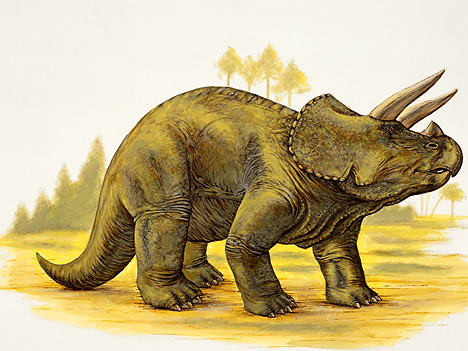
The Jurassic Period was in the middle of the Mesozoic Era, somewhere around 200 million to 145 million years ago. In this era, dinosaurs roamed  the Earth.
What was changed in that period?
More floods of lava occurred from fissures and  volcanoes. There were more Archosaurian reptiles; the population of dinosaurs, pterosaurs, and marine reptiles all increased, gymnosperms were the most dominant plants, and small mammals began appearing.
What was changed from then to now?
Dinosaurs now.
Well for starters, there are no more dinosaurs in the face of the Earth. The environment back then was much more humid than nowadays. The sea-level is lower than in the Jurassic Period. South America has parted from Africa.

References:

[BOW 2-4] Natural Selection

What is natural selection? How does it relate to mutations, genotypes and phenotypes? What is an exaptation?
Natural selection is the process of which organisms better adapted to their environment survive to reproduce. It does not affect the rate of mutations that occur, nor does it affect genotype because that is already fixed. Phenotype can be affected because you must be able to adapt to your environment.

An exaptation is the use of a biological structure or function for a purposed in which it was not intended for.

References:
http://www.google.com/search?q=what+is+an+exatation&ie=utf-8&oe=utf-8&aq=t&rls=org.mozilla:en-US:official&client=firefox-a#hl=en&client=firefox-a&hs=Xhc&rls=org.mozilla:en-US:official&q=exaptation&tbs=dfn:1&tbo=u&sa=X&ei=kxxQT6eYAYiliQLjiuW0Bg&sqi=2&ved=0CCEQkQ4&bav=on.2,or.r_gc.r_pw.r_qf.,cf.osb&fp=9d2590dd2d0e3399&biw=1200&bih=638

[BOW 2-3] Cloning: Extra Credit Question

Who has the right to have children, no matter how they are created? Who doesn't? Why?
All living beings, humans and animals alike, have the right to have children. Clones are made to be an exact replica of the DNA donor. If the clone if the exact copy of a human, it is still a human--just an artificial one. However, even clones have the right to birth children. The question now is, who should have children?
 If you have proper income, experience with children, shelter, and care skills, then you have the preferable conditions to raise children. Some children turn out differently from others, with special needs which require more special care. A clone would rarely reproduce a healthy infant. And even if it did, scientists will probably ruin its life by monitoring it and taking notes on it and using it to proceed scientific research. 
Maybe they''ll even do a test to see how a clone's baby's life will sail in comparison to it's parent. Probably even worse, I'd say. Could not be any better than what I wrote in my older post. A clone's life will always revolve around science. 
Science and ethics are basically different things, maybe even rivaling like science vs. faith. A clone of a human would not be able to resist having feelings and forming ethics. Oh, how conflicting the clone will feel. Like I said in my other post, the clone might kill itself from depression before even bearing children. While a clone has every right to make babies, it should not. Would you eat a pizza, when you have the right to, if it was a bad pizza?

Thursday, February 16, 2012

[2-3] Cloning

What are some of the social challenges a 


cloned child might face?


A cloned child will face a lot of problems. Especially since a clone is very liable to develop feelings.
Feelings are a very powerful thing, though many would not consider it science.
Of course, plants are okay to clone because plants benefit everyone, for food and oxygen. The more plants, the better (but not too much or else there will be a plant apocalypse).
Maybe cloning animals are okay, too. Because it can help make more endangered animals, and more source of food.


Cloning humans, I believe, is extremely dangerous. And yes, basically for the sappy reasons like feelings&emotions. If I were a clone and I realized I was merely a creation of science, and not love, I don't know how I would cope. Here is a brief overview of how I imagine a cloned child to grow up:


Childhood: The clone has no parents, unless it's original human form was considered a human. Growing up without parents is a tragedy. If someone made a clone of me, why would I hang around it? Even if I did, how am I supposed to take care of it? Welfare or something? This is not my baby; this is science and there is no love. It would be very difficult for the clone to make friends, too. Since a clone has it's original form existing with it, peers would have a hard time accepting the clone, probably being freaked out.


Adolescent: It is never guaranteed that a clone would come out perfect. Hormonal problems may occur. On the other hand, if there are no hormonal problems, the clone would be very lonely. Since adolescent is the period of time in which teens become more emotional, the clone would be that to the highest extent. No parents, no friends, probably only the scientist who created it would probably care for it. It might commit suicide from sadness. But if not...


Adult: The clone would probably be very sexually frustrated. I don't think much people would want to date or marry someone if they knew he or she was a clone. Since having babies might be a concern for many adults, they would not opt for a clone as a parent; problems with it's birth may occur. It is not safe. 


I am very much against cloning. I think cloning is basically science vs. nature. You should not fight against the way things have sufficiently worked for centuries. Who would want to be cloned anyway? Why would anyone want a copy of themselves out there? Even when someone wears the same shirt as you, people get worked up. Cloning humans will do us no good, in my opinion.